Flow-Matching Driving Planner — Trajectory-Representation Ablation
Ablated four trajectory representations (Cartesian waypoints, Frenet, velocity, acceleration) inside a vendored NeurIPS-2025 flow-matching planner (Tan et al.), training each variant on 1.5k-scenario subsets drawn from an 80k-sample nuPlan-mini cache. On open-loop ADE (average displacement error), Cartesian waypoints performed best — roughly 5x lower error than the velocity- and acceleration-based representations (4.19 m vs ~22 / 20 m).
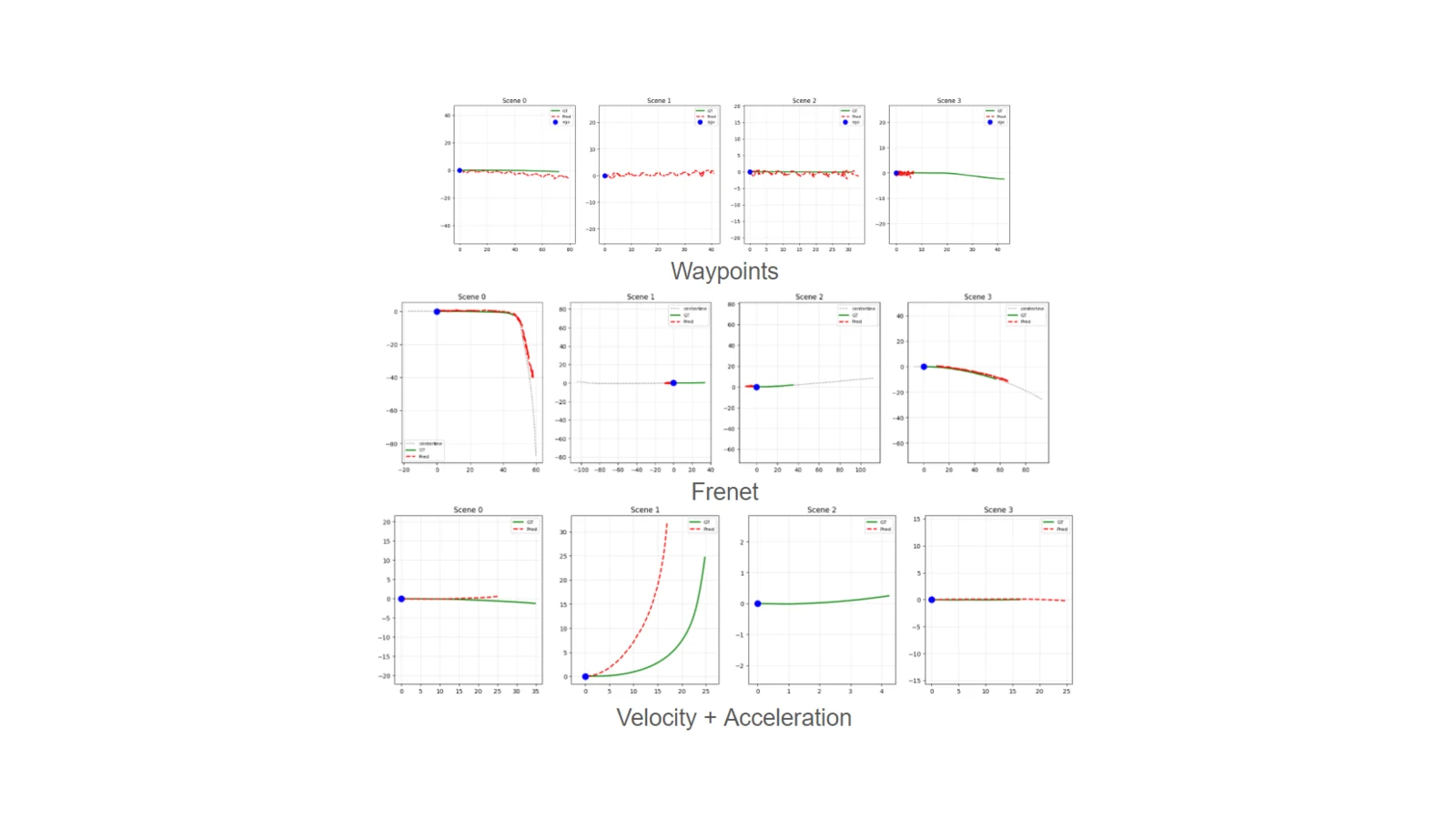
An academic project ablating four trajectory representations (Cartesian waypoints, Frenet, velocity, acceleration) inside the Flow Planner (Tan et al., NeurIPS 2025), which I vendored into the project. I trained each variant on 1.5k-scenario subsets drawn from an 80,000-sample nuPlan-mini cache (the Frenet headline run on 5k) and compared them on open-loop ADE (average displacement error — the mean distance, in meters, between the planned trajectory and the ground-truth trajectory, over 300 held-out scenarios; lower is better).
Cartesian waypoints performed best: their open-loop ADE (4.19 m) was roughly 5x lower than the velocity- and acceleration-based representations (22.3 m and 20.0 m). Frenet was weakest in the 1.5k baseline but became competitive (≈21 m at 5k) once I added centerline conditioning. In short, predicting raw (x, y) waypoints stayed far closer to the true path than predicting motion derivatives and integrating them.
I also designed a route-aware “smart centerline” picker and a CenterlineEncoder
conditioning module for the Frenet representation, scripted reproducible single-
and multi-seed experiments (seeds 269, 1337, 2026), and co-authored a written
report.
Repositories: the main project lives at CS269FlowPlannerProject; it builds on my fork of the official Flow Planner.